In my previous blog, I mentioned having leftover homegrown zucchini and yellow squash. We’re going to eat squash dishes all week with our harvest! I ❤ growing and eating my own food. Anyone with a space for a container can grow some vegetables, such as squash, or tomatoes, or peppers, or herbs. My chamomile plant went nutball, and we had to transplant it to a larger pot. I ❤ harvesting the flowers for chamomile tea!!! Gardening is fun. Hope you’ll try it!! Plus, with organic potting soil, you can rest assured you’re not eating agrochemicals. 🙂
Shane prefers his squash cooked, so I made a squash au gratin that was so good we had no leftovers!!!
It’s a super simple, light comfort food. And delicious like you wouldn’t believe! All you need are one and a half of the summer squashes. I used the remaining halves of my zucchini and yellow squash, and sliced up another yellow squash. I chopped 1/3 of a sweet yellow onion.
To make, layer the casserole dish by alternating the zucchini and yellow squash. Top with diced onion. Add a dash of herbs. Dot it with butter (from grass fed, pasture raised cows..better for the cow, for the environment, and for you) or vegan spread (look to see if it uses palm oil and if so check if it’s sustainable on RSPO or Green Palm. Unsustainable palm oil leads to deforestation and endangerment of tigers, orangutans, rhinos, and elephants). Sprinkle on mozzarella and cheddar cheese (grassfed and pasture raised!!!). Repeat the layering until you run out of casserole space. 🙂
Bake at 400 degrees for 30-45 minutes, or until you feel the cheese is done to your liking, and the squash is a bit tender.
It serves 2. Maybe. Depends on if you’re sharing with someone like me who can’t eat a lot because having Ehlers Danlos Syndrome (EDS) means my stretchy stomach triggers the full sensor nerve too early, and I have early satiety. Shane had to finish my plate. I’d had bigger eyes. 😛
That’s a mouthful. To say and to eat if you pop one or two mini cups into your mouth. Except me. I have to take small bites because I can’t open my mouth very far. I have TMJ dysfunction with a closed lock, courtesy of EDS. My oral surgeon and my former PT don’t even know where the disc is. It’s dislocated mysteriously.
Eating is challenging when your food falls off forks and spoons due to narrow passage. But, my other issues create even more eating limitations and difficulties. One, I’m a vegetarian. Two, I have to eat a very low carb diet because I have an insulin problem. My pancreas overproduces insulin (assuming it’s related to EDS like everything else!). All of my life I’ve suffered hypoglycemia, otherwise known as low sugar. However, over time, my cells stopped uptaking insulin. This led to high insulin in my blood, and lots of water weight gain (16 pounds to be exact). Water retention and high insulin can cause organ failure. My doctor told me to “eat like a diabetic”. Except I already did.
So I did a bit of research. I found literature on high insulin diets, and one diabetic expert who had diabetes stated the ADA recommendation for 120 g of carbs daily was too high. He suggested 50-60 g/day. And like any good scientist, I did an experiment for 6 weeks, eating only 50-60 g/day. Oh, it was very hard as a vegetarian. But I adjusted AND my next blood test revealed optimal insulin levels. Best of all, I lost all the water weight. 🙂
While on this low carb diet, I learned I had a gluten sensitivity. It would trigger the worst headaches. I thought I would cheat with French toast. Nope. Thus, I also can’t eat foods with gluten.
But I’m a hobbit and always hungry. It’s super easy to blow my carb limit if I don’t count or “budget”. Then I end up peeing like a bladder-bloated racehorse. Copious and frequent. Annoying to say the least.
What’s a hungry hobbit to do? A hobbit with a sweet tooth, mind you. Experiment with almond butter, clearly. 🙂
Almond butter has 3 g of carbs per 2 tbs. As well as 7 g of protein and 8 g of fat. Fat and protein help vegetarian hobbits feel full.I decided to see what would happen if I mixed almond butter, cream cheese (the secret to baking with almond flour), eggs, Swerve, and mini chocolate chips and baked in a mini muffin pan.
The result:
They turned out like muffins. Flourless muffins. 🙂
They’re dense and not very sweet. But the little bits of chocolate chips touch my sweet tooth. 🙂 These will not appeal to people who eat sugar or soft white flour. Lol Though I have made gluten-free pumpkin scones that pleased those lucky can eat anything in a bakery types.
The recipe is quite simple. Soften half a brick of cream cheese and a cup of almond butter in the microwave for a minute or two, then blend. Remember to store your natural nut butters upside down so you don’t have to stir the oils. You’re welcome. 🙂
Add 1/4 cup of Swerve. The erythritol doesn’t affect my insulin at all, so I use it in baking. However, if you can have sugar and don’t count carbs, by all means, sweeten it your way! Blend.
Next beat in 2 eggs. Stir in 1/4 cup of chocolate mini chips (or more if you don’t have to watch your sugar). They do make chocolate chips with Swerve or sugar substitute, but they’re too expensive for me. Therefore, I can’t use a lot.
Line the mini muffin pan and fill the cups. Bake at 375* for 10-15 minutes, or until puffy and firm. Or soft. I’m not sure yet how done I want them yet. 🙂
Ingredients
4 oz. Cream cheese (from grass fed, pasture raised cows)
1 c almond butter
1/4 c Swerve (or your favorite sugar substitute or sugar)
2 eggs (from pasture raised hens)
1/4 c mini chocolate chips
If you’re low carb like me, enjoy 2 a day as a snack. Should be about 10 (15 at most) carbs total. Maybe enjoy with a cup of unsweetened almond milk. 🙂
Clearly we’ve nicknamed our camper “Honey.” 🙂 For the last 3 weeks, our camper sat at Camping World, awaiting service to fix the water heater, a few leaks, and the DVD player on the TV. It sat without a single look-see. It sat neglected, while we parked ourselves in a hotel, feeling deprived of home and wasting money. 😡
During that time when Camping World failed to do their job, I did my job hiking still. I visited Beaver Creek State (OH), Raccoon Creek State Park (PA), Sewickley Heritage Park (PA), Brady Run Park (PA), and Tomlinson Run State Park (WV). None compared to Mcconnells Mill, but I enjoyed each wandering into wonder. Spring has sprung!!!For a few days, I did have to stay in the hotel room. Shane had either gotten toxic exposure at work or sick (tested negative for the flu). On his worst day, he had a 102.2 fever and a throat filled with pus. I had to play nurse, and it felt like a hospital room. Luckily he recovered quickly, even though he missed 4 days of work.I didn’t get sick, but I’ve had vertigo and dizziness for 2 weeks now. I’ve had to grab Shane or nearby structures to stop my fall. Once I fell on the bed, and another time I fell seated on the toilet when I hadn’t quite removed my pants. *sigh*I was diagnosed with benign positional vertigo about 15 years ago. They believe it stemmed from the head injury when I was hit by a car as a pedestrian. But I’m starting to wonder if it’s inflammation from cervical instability or my elongated styloid process pressing upon my carotid artery. I now spin when lying straight back or sitting up. Don’t even need to turn my head.Perhaps I can even blame the hotel bed. It’s hard as a rock, and my shoulders pop out every night and snap back in every morning. Hello, Arthrosis. I’ve had unrelenting pain between my thoracic spine and scapula. Not sure what’s out of place.But we’ve felt displaced without our camper. It might be too small, but it’s home. We’re more comfortable body, mind, and soul.So on the day his jobsite closed for the afternoon because of inclement weather, he decided we’d pick up the camper despite the lack of attention and repair. He figured he’d try to fix it. But he didn’t want to stay another day in the hotel, and we had new campground reservations we wanted to honor.I told Shane I wanted to speak to the manager to lodge a complaint and get the corporate number. We were supposed to have the camper back on the 6th, and it was the 12th and they hadn’t even looked at it. Unacceptable!!! Shane didn’t think I should bother, but you never know right? And what do you know…the service manager listened to me calmly and politely explain the situation and he asked if it would help if he brought two technicians out to inspect camper. Of course my t-shirt may have motivated him.Lo and behold, a couple hours later they addressed all our concerns. Supposedly we never even needed to drop off the camper. This triage work was how it wa s supposed to be handled. While I’m happy and grateful to the team we have an operable water heater, seals on the leaks, and a new TV with DVD player on order, I’m steamed about the situation. They really dropped the ball in the beginning and the following weeks. Each call was answered with “soon” until Shane’s like “What is soon? It’s been 3 weeks, brother.” Grrrrrrr!!!!But now we can shower and do dishes. :)And we have made a few other changes to our former ways. We replaced the mattress I didn’t like with an air mattress and gel foam topper. It’s definitely more comfortable for my joints, and I’ve slept better! Additionally we bought a shepherd’s hook upon which to hang our bird feeders and tiki torches to ward off bloodsuckers.Soon we’ll enjoy eating outside!!! When I go back home, I’m going to pick up my planters and our veggie seeds. I’ll do some container gardening!! :)It’s good to have the Wanderful Life again!! ❤
I have Ehlers Danlos Syndrome (EDS) hypermobility type and hike.
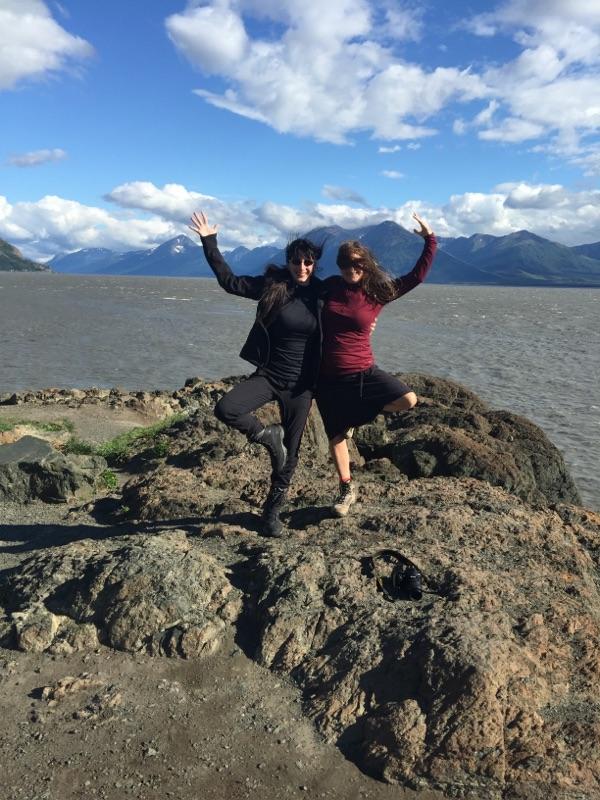
Teri on Mary’s Rock, Shenandoah NP Teri on Mary’s Rock, Shenandoah NP Kat and Teri Trees near Anchorage, AK. T’was windy. You can’t see the evil I gave. 😛
It sounds like the start of a support group, and maybe it is. For those afflicted with EDS, frequent joint dislocations/subluxations, chronic pain, and fatigue but who want to stay active on the trails like I do, then support is exactly what we need. I’m talking stability belts, braces, tapes, and hiking poles in this case. 🙂 However, I’m also here for you if you seek emotional support as well. ❤ I completely understand loving an activity and struggling to continue with it, or having to give it up entirely—yoga and dancing, for me. 😥 Kayaking and cycling are questionable at the moment. However, to keep me hiking, I’ve spent the last year working with the best physical therapist I’ve ever had (and I’ve had many, for different joints, over the last 25 years). Dave Miers is the only board certified orthopedic and fellow trained in manual physical therapy in Cincinnati, Ohio, and I owe him my life (on the trails). https://www.mierspt.com/
About twenty-plus years ago, I fell in love with mountain hiking. I did my first summit hike in the Uintas Mountains and have since blazed every day-hike trail possible in the Wasatch Mountains in Utah. I’ve hiked stunning canyonlands in Utah as well: Bryce Canyon, Snow Canyon, Zion National Park. I’ve booted many miles in reserves, state parks, and national parks in many other states too: Alaska, Hawaii, Colorado, California, Montana, Nevada, Virginia, West Virginia, North and South Carolina, Florida, Georgia, Tennessee, Kentucky, Ohio, New York, and lately Pennsylvania. I’ve even put in miles in Grand Cayman, France, Italy, and England. If I had my way, I’d hike the entire planet.
But, a little over a year ago, I couldn’t even walk a quarter of a mile.
Why? This requires a little background information…
I have problems with most of my joints; it’s probably easier if I list the unaffected ones: ankles and toes. Although, my left foot is perpetually swollen because of tissue fragility and leaking cells. Anyway, this post is about the powerhouse of walking: the pelvis and sacroiliac joint. You thought I would say legs, didn’t you? 😛 Guess what they’re connected to? 😉
So…I’ve had “hip” pain since I was 32 years old (I’ll turn 51 this April 2019), and seen various orthopedics and physical therapists to help me to no avail. I’d even had surgery for FAI impingement in 2014 and steroid injections. As it turns out, it’s not quite my hip joint–it’s my entire pelvis, which one physical therapist who specializes with EDS patients called “wibbly wobbly.” She actually “fired” me from her care because my pelvis was too hypermobile! Yes, my pelvis is very hypermobile, the most hypermobile of any of Dave’s EDSers. The root of my problem is “loosey-goosey” (doctor’s phrase, not mine. I’d say “lax”) ligaments and sacroiliac (SI) joint dysfunction.
The strongest ligament in the body on me is too stretched, too loose, and cannot hold the joints in place. Quite often I suffer subluxations, or partial dislocations, of my sacrum and/or my ilium. If they go, then the lumbar spine tends to follow. Basically I’m Humpty Dumpty, and my physical therapist has to put me back together again, and again, and again. After adjustments, he guides me through different strengthening and stabilizing exercises, and amps the challenge as I master some. He’s taught me how to properly walk, sit, stand, enter/exit a vehicle, and climb stairs–yeah I did all those incorrectly because chronic pain has a way of rewiring your mechanics and disconnecting the brain. A lot of the therapy is retraining your brain with the body, and I have gotten stronger and gained more of my function and ability back, at least when it concerns walking/hiking.
Although my sacrum pops constantly out of place, typically the left side shifting downward and twisting inward, my ilium stays more often than not in its neutral, normal position. That said, two months ago I partially dislocated my ilium while rolling over in bed and reaching down to turn off my alarm. Yeah, I hurt myself sleeping. If you have EDS, you probably have as well. I did learn self-correcting techniques for my sacrum and my ilium, and I can say it’s easier to reset your ilium than your sacrum. I’ve only ever been successful once. At least intentionally, I’ve “accidentally” self-corrected randomly simply by being and moving around with enough force to correct it. Or coughing. I seemed to have popped my sacrum today with a cough–though, in or out, only an x-ray or my physical therapist would know.
If you have SI joint dysfunction, you might be interested in these videos for self-correcting the sacrum as suggested by Dave Miers:
Self-correction for the ilium. If the one side doesn’t work, try the other!
Now, for the gist of the matter: Hiking Tips for the Hypermobile Hiker!
1. Consult your doctor and/or physical therapist about the type and intensity of activity that suits your ability. As I’ve mentioned, I’ve had to quit certain activities and for what remains I’ve had to accept limitations and modifications. I can hike within reason but can no longer do rock scrambles, or very strenuous or very long hikes. I tend to hike the easy-to-moderate trails now. Even though my physical condition and abilities have declined, I am better off than many with EDS because I maintained a very active lifestyle and kept as fit as possible, considering. I might be the most hypermobile EDSer under Dave Mier’s care, but I’m not in the worst shape. I’m a proponent of “move it or lose it” despite doctor’s advise to stop, despite the fact one told me I was “very brave” to do what I do. As I tell my mom who worries, I’m going to hurt myself “being”; I might as well hurt myself having fun. 🙂 Your opinion may differ. 🙂 But attitude is part of the battle in managing EDS. Pain is much harder to cope with if you’re also depressed. ❤ Hiking is my natural anti-depressant.
Not only consult the experts about what to do, but how you should do it. Dave designed my program centered on my goal to hike. His individualized care has made a world of difference. I can’t give you medical advice on what exercises you should do and leave those tips to your care provider. I highly recommend finding a manual physical therapist fellow–trust me, I’ve been seeing physical therapists since I was 25 years old, and I’ve failed physical therapy every time until I met Dave Miers.
2. Buy the best pair of sturdy boots you can afford. You’ll need the best footing possible on uneven ground, slippery rocks, snow, muck, when you ascend and descend, if you can rock scramble. Sole tread and grip matter too. If you have wobbly ankles like I do, then you’ll need good ankle support. You’ll need good arch support. Ultimately, the boots will have to be comfortable. REI has a rock prop for you to test boots. Or hiking shoes, if you decide you don’t need ankle support.
My new spring, summer, and fall Oboz boots (https://www.rei.com/b/oboz), and my winter Columbia Arctic omni-heat and omni-grip boots (https://www.columbia.com/technology-omnigrip/). Unfortunately the Arctic Trip boots are last season and probably unavailable. Wearing those boots keeps my feet warm, and I rarely have warm feet in the winter!
3. Get some trekking poles with a comfortable grip. I couldn’t believe the difference hiking with and without poles, and wished I’d been using them the entire time. Using the poles takes the pressure off my knees. Usually after hiking my knees would swell and hurt. Now I can hike without knee pain! Or a knee brace or tape–neither of those helped me because my knee caps move way too much. As an aside, one time during physical therapy, I mentioned my knee kept moving while I did the exercise. Dave tried to hold it in place while I performed the motion. My knee still moved! He gave up, knowing it was a lost battle. Wiggly knee wins every time. So, who wants to buy my expensive knee brace that can’t hold my knee? Only used once. 🙂
4. Wear your joint stabilizing belt, braces, or tape. I gave up the knee brace, but for my SI joint dysfunction, I wear a sacroiliac belt. Although the belt doesn’t hold my wigglier-than-my-knee sacrum in place, it definitely keeps my ilium locked in a normal position when I hike (not so much when I kayak). The one time I forgot to wear my belt on a short forest hike I ended up with a twisted torqued pelvis. Furthermore, the SI belt may not protect you if you fall.
Taping or wearing shoulder braces will also help your SI joint–subluxation of the shoulders will cause subluxation of the cervical spine, which will cause subluxation of the SI joints. Shoulder bones connected to the hip bone. 😛 I can’t tape myself and haven’t yet decided on which brace to buy (too many options). If you have a favorite, please let me know in the comments. 🙂 I still think a biomedical engineer needs to create synthetic spider webbing for us EDSers. 🙂
5. Get professionally fitted for a backpack. You’ll regret hefting the weight if you carry the wrong backpack for your body. The unbalanced weight will strain your neck, shoulders, back, hips, and knees, and you’ll ache at the very least. Matter-of-fact, my physical therapist advised wearing a backpack instead of carrying or pulling luggage. I wear a small backpack instead of carrying a purse to balance the weight, and of course I have an XS 40L backpack for my back-country trips, but I only carry 20-25 pounds (ultralight backpacking!). https://www.ems.com/the-north-face-womens-terra-40-backpack/1304688.html
6. Know your limitations. Hike only as far or as long or at the difficulty level your body can handle. Don’t hike twelve miles as soon as you get the green light from your physical therapist and then complain about hurting. Not saying this happened to me, but it happened to me. 🙂 I tend to overdo it, but on long backpacking weekends, I now only hike to the point I feel the first sting of pain and stop. I no longer push myself through the pain, which is what I’ve done all my life until the last year. Understand your thresholds, whether it’s distance, exertion, temperature, fatigue, pain. These may help you avoid injury or the inflammatory flares.
7. Prepare to manage the inflammatory flares. Even on long backpacking trips, I bring what’s necessary to decrease inflammation. Inflammation is a state of being when you have EDS, and working joints and muscles will exacerbate inflammation. I rely upon a variety of measures: (1) grape seed extract and turmeric extract; (2) portable TENS; (3) Max-Freeze (I prefer it over Biofreeze and Icy Hot); (4) my icy gel pack or ice; and (5) rest. ACE bandages and shoulder slings come in handy too. I also take Indomethacin, a prescription non-steroidal anti-inflammatory, daily because I have hemicrania continua, a rare chronic headache condition. I’m not sure if Indomethacin helps my joint pain because I always have joint pain, but maybe the pain would be worse if I didn’t.
What tried-and-true at-home self-care methods do you use?? 🙂
8. Adopt an anti-inflammatory diet. Certain foods produce a pro- and anti-inflammatory response in your body. You’ll find lots of information on the internet about an anti-inflammatory diet, which foods to include, which to exclude.
As for me, I opted for a vegetarian diet 18 years ago, but, because of high insulin and low sugar health problems, I needed to further restrict myself. I only consume 50-60 grams of carbohydrates a day and eliminated gluten. As a result, I feel better, lost 16 pounds of water weight caused by high insulin, and experience the benefit of pain reduction, especially for my headaches. I discovered gluten triggers the worst of my head pain. I will admit my diet presents a challenge at times and demands careful planning to meet my nutritional and appetite needs. The benefits far-outweigh the cost of effort though.
In my camper cooking blog (https://wordpress.com/block-editor/post/thewanderfullife.home.blog/158), I mention I’m a fan of organic foods. I’m also a fan of non-GMO foods (because of the lack of transparency–what’s in my food? An additive that’s pro-inflammatory? A chemical that artificially raises insulin?) and sustainably produced foods, such as eggs and dairy from pasture-raised animals, or palm oil, which if not sustainably produced contributes to deforestation and the endangerment of tigers, elephants, rhinos, and orangutans. 😦
If you watch Forks Over Knives (Netflix), you’ll learn a lot about the food industry and human, animal, and environmental welfare. Adopting a whole food, plant-based diet could reduce disease risk and boost your health and body’s maintenance and function.
An EDS expert states the whole food diet, as well a paleo, raw, Mediterranean, and vegetarian/vegan follow the approach she recommends for those with EDS. Many of us have digestive issues, such as gastroparesis, or food sensitivites because of mast cell activation syndrome (MCAS). We need the most appropriate fuel for our bodies. I’ve provided the link to that information: https://issuu.com/markmartino8/docs/eds_nutrition_and_supplements_heidi
9. Repair and build muscles with a protein bar or drink. While whole foods contain the amino acids your body needs to repair or build muscle, I feel my muscles need the extra boost. Overstretched, weakened ligaments and tendons cannot hold the joints as intended, and cause joint instability. The muscles, thereby, double duty as muscles and connective tissue, holding the joints and moving the joints. Fatigue and spasms ensue.
As you age, you tend to lose muscle, but as someone with EDS, you need more muscle. It feels like an uphill battle, and sometimes I think all I can do is maintain my muscle rather than increase muscle mass. I tell my children–my daughter confirmed with EDS, my son suspected–to get strong and then get stronger. That’s the legacy I leave for the genetic lottery we’ve won.
My favorite brands of protein powder are Garden of Life and Sun Warrior. They both have BCAA’s the building blocks for muscles. Since I have a low-carb diet and need to avoid maltodextrin/dextrin (raises insulin), I have two choices for bars: Quest Bars and Power Crunch’s Snapsticks. Also, I ❤ the Koia convenient ready-made protein drinks ( https://drinkkoia.com/). Other options to increase protein and omega-3 fatty acids are flaxseeds, chia seeds, and walnuts. The problem with those is the volume you need to eat. 🙂
10. Use foam rollers to stretch and calm your muscle tightness. My most important rule: NO STRETCHING! Stretching only further weakens already over-stretched ligaments, and you’re more likely to hyperextend a hyperflexible and hypermobile joint. We all know what that means: PAIN and DAMAGE to the joint.
The first time I used a foam roller on my quads I wanted to cry. Yet, over time it does work. I have a large roller and small roller. You’ll find a myriad of roller types and size. For some spots, you can even use a tennis or rubber ball.
If you can afford the luxury, pay for a medical massage. They hurt more than the roller, but…:)
11. Enjoy life and this world. We’re not long in it, and you might as well go into the grave with a defective, broken well-used body than a hardly used one. You’re going to hurt yourself no matter what you do.
If you have EDS and TMJ you’re not allowed to yawn. You have to push your thumb against the bottom of your jaw to keep it from opening.
You might as well enjoy the sights and sounds, even if the sounds are your joints popping.
Some trails and scenic lookouts are wheelchair- or walker-accessible. Don’t let disability actually disable you from experiencing wandering into the wonder. ❤ I’m hiking with my legs until I can’t use my legs, and then I’m going to hike with my arms, or make Shane push me. 🙂 http://wheelchairwandering.blogspot.com/2017/05/accessible-trails.html
I’m going to be in pain, whether I sit, stand, walk, talk, eat, or breathe. At least when I’m hiking I have a very good and acceptable reason for the pain. 🙂


 For a few days, I did have to stay in the hotel room. Shane had either gotten toxic exposure at work or sick (tested negative for the flu). On his worst day, he had a 102.2 fever and a throat filled with pus. I had to play nurse, and it felt like a hospital room. Luckily he recovered quickly, even though he missed 4 days of work.I didn’t get sick, but I’ve had vertigo and dizziness for 2 weeks now. I’ve had to grab Shane or nearby structures to stop my fall. Once I fell on the bed, and another time I fell seated on the toilet when I hadn’t quite removed my pants. *sigh*I was diagnosed with benign positional vertigo about 15 years ago. They believe it stemmed from the head injury when I was hit by a car as a pedestrian. But I’m starting to wonder if it’s inflammation from cervical instability or my elongated styloid process pressing upon my carotid artery. I now spin when lying straight back or sitting up. Don’t even need to turn my head.Perhaps I can even blame the hotel bed. It’s hard as a rock, and my shoulders pop out every night and snap back in every morning. Hello, Arthrosis. I’ve had unrelenting pain between my thoracic spine and scapula. Not sure what’s out of place.But we’ve felt displaced without our camper. It might be too small, but it’s home. We’re more comfortable body, mind, and soul.So on the day his jobsite closed for the afternoon because of inclement weather, he decided we’d pick up the camper despite the lack of attention and repair. He figured he’d try to fix it. But he didn’t want to stay another day in the hotel, and we had new campground reservations we wanted to honor.I told Shane I wanted to speak to the manager to lodge a complaint and get the corporate number. We were supposed to have the camper back on the 6th, and it was the 12th and they hadn’t even looked at it. Unacceptable!!! Shane didn’t think I should bother, but you never know right? And what do you know…the service manager listened to me calmly and politely explain the situation and he asked if it would help if he brought two technicians out to inspect camper. Of course my t-shirt may have motivated him.
 Lo and behold, a couple hours later they addressed all our concerns. Supposedly we never even needed to drop off the camper. This triage work was how it wa s supposed to be handled. While I’m happy and grateful to the team we have an operable water heater, seals on the leaks, and a new TV with DVD player on order, I’m steamed about the situation. They really dropped the ball in the beginning and the following weeks. Each call was answered with “soon” until Shane’s like “What is soon? It’s been 3 weeks, brother.” Grrrrrrr!!!!But now we can shower and do dishes. :)And we have made a few other changes to our former ways. We replaced the mattress I didn’t like with an air mattress and gel foam topper. It’s definitely more comfortable for my joints, and I’ve slept better! Additionally we bought a shepherd’s hook upon which to hang our bird feeders and tiki torches to ward off bloodsuckers.
 Soon we’ll enjoy eating outside!!! When I go back home, I’m going to pick up my planters and our veggie seeds. I’ll do some container gardening!! :)It’s good to have the Wanderful Life again!! ❤




 Anyway, this post is about the powerhouse of walking: the pelvis and sacroiliac joint. You thought I would say legs, didn’t you? 😛 Guess what they’re connected to? 😉


 The Wanderful Life