On the internet, you’ll find a lot of posts about safely cooking with your propane-fueled stove, how to estimate how much propane remains, how to light the burners, and “everything” you wanted to know, EXCEPT…
…what to do when you’re about to cook and you run out of propane or lighter fluid!
I’ve lived in our 15ft travel trailer for a month and have experienced both. While I may not be an expert on full-time camper living, I am quite adept at handling chaos. I am a dark fantasy writer, after all. Gods and monsters are my thing. 😉
Rules to Save Your Breakfast, Second Breakfast, Elevenses, Lunch, Afternoon Tea, and Dinner
1. Always have extra propane tanks, filled and ready to switch out the emptied.
2. Always have extra lighter or matches on hand to replace dead lighter.
3. Always have alternative cooking methods.
–We have the convection oven microwave and an Instant Pot. Even the electric tea kettle would do to heat water for oatmeal or any other just-add-water instant foods.
4. Always stock your pantry or refrigerator with foods that don’t require cooking.
–Salads, sandwiches, cheese, hard-boiled eggs, fruits, vegetables and dip, pita bread and hummus, nut butters, seeds and nuts
Our long-reach lighter wouldn’t spark this morning, and I’d already broken the eggs and whisked them with cream and feta cheese. While we had an extra lighter, I didn’t know where Shane stored it. Perhaps that should be a rule: know where you keep your supplies. 🙂 So, I’d texted Shane but was too hungry to wait for his reply. Patience is not always my virtue. So instead of making scrambled eggs, I poured the egg mixture into a ramekin and baked a crustless quiche. 🙂
I had to eat my cinnamon-sprinkled toast and drink my green jasmine tea before eating my eggs, but in the end it worked out for me
Note: The vegan spread has essential omega 3-fatty acids; the cinnamon on the toast is a natural anti-inflammatory; and the jasmine green tea also has anti-inflammatory and insulin regulation benefits and powerful antioxidants to improve immune system, skin, and heart health.
The final rule should be: Be flexible and creative when cooking chaos happens. Because it will happen, no matter much you know about how a propane stove works or how to avoid carbon monoxide poisoning.Herbed feta quiche
His frosty breath battered our door, our vent, our windows day and night as he sought his way in.
Try as he might, he couldn’t quite reach us. We had armored ourselves just enough, and fought his frigid grasp.
He bellowed outside our door.
As if trembling in fear of his anger, our camper shook.
The Abominable Snowman spit and frothed, encasing us in ice, trapping us inside.
Until he wearied of his tantrum and turned his cold gaze toward another prize, we waited in the warmth of our tiny castle. It wasn’t the strongest fortress clearly, but it withstood the worst we would most likely experience this winter.
Except what we encountered on the Oregon Trail…
We spent our time playing games with/against each other, such as The Oregon Trail card games and Quiddler, playing games on our phones (me: Bejeweled Stars, Toy Blast, Toon Blast, and Words Against Friends; Shane: Last Day on Earth), watching Avengers Infinity War (again) off Netflix, and simply enjoying each other’s company.
With plenty of food and flowing fresh water (we combated frozen pipes previously and learned from our battle loss Camper Living in the Winter: Frozen (Water Pipes)….Let it Go!), we could wait out this siege without concern. I made zucchini corn chowder to counter the ice and sub-zero temperature invasion. Soon I will share my kettle secrets.
The Polar Vortex accompanied his friend the Abominable Snowman. With a weakened, wavering jet stream from global warming, a part of the Polar Vortex legion escaped the North Pole and headed south for prey. A fierce freezing force not all could defend against, a dozen lost their lives thus far.
Strong winds and wind chills, the fists of the Polar Vortex, pummeled temperatures dangerously low, -50*F in some places, -21*F where we temporarily call home. While not foolproof against the Abominable Snowman, our planning helped us prevail against the odds. It’s a Wanderful LIfe!
We escaped eventually. Though, the Abominable Snowman lurks nearby still. But we have armed ourselves with new knowledge and will experiment with other fortifications.
With you, my winter camper comrades, I’ll share what I consider the best wisdom of others who have survived the Abominable Snowman too.
How did we accidentally make clotted cream? Well we had a mason jar of Snowville heavy cream in the refrigerator. Seems it was a bit too cold, and the cream solidified. I sampled it to see if had gone rancid, but it tasted buttery and sweet, like clotted cream!
But what use did we have for clotted cream? Yes, scones of course. 🙂 I love tea, tea parties, and baking. See my Pinterest board on the topic:https://pin.it/cjyh3nxjram6rr
However, I hadn’t yet experimented with the camper’s small convection microwave oven for baking.
And, I had only ever made one low-carb, gluten-free scone in a conventional oven (pumpkin scones—a surprising hit at the tea party! I’m the only one with the restrictions.).
This would be a challenge!
I don’t like most of the recipes for low-carb gluten-free, so I’ve been trying to create my own, to suit my bakery snobby tastes.
I didn’t have a lot of ingredients on hand, so I worked with we had. They didn’t need to be fancy, and we didn’t have jam. The only acceptable option was cinnamon scones.
As a cheat to moisten dry almond and coconut flours, I use 2 ounces of cream cheese. I blended this with 2 eggs, 1/4 cup of Swerve and 2 tablespoons of coconut sugar, a cup of almond flour, 1/4 cup of coconut flour, teaspoon of baking powder, half teaspoon of baking soda and salt, teaspoon of vanilla, and teaspoons of cinnamon because you can never have too much cinnamon. 🙂
For scones, you’re supposed to keep everything cold, especially the butter. You cut it into pats and blend with flour until mealy. Then add the wet.
The pastry batter will not be as firm as regular scones. But you can shape it into a round. I didn’t bother to cut into wedges. I didn’t know if the baking would work because roasting still has its quirks.
But it baked well enough at 350 for 15-20 minutes. Though cutting them into wedges before baking would’ve been better. Still, I enjoy the extra moistness from not cutting them.
I enjoyed my tea time too! Cinnamon scone smothered in clotted cream! Yum!
Ingredients
2 ounces softened cream cheese
4 ounces butter
2 eggs
1/4 c Swerve
2 tbs coconut sugar
1 c almond flour
1/4 c coconut flour
1 tsp baking powder
1/2 tsp baking soda
1/2 tsp salt
1 tsp vanilla
3 tsp cinnamon
Bake at 350 (convection) for 15-20 minutes. Serve with clotted cream, sprinkle of cinnamon, and your favorite cup of hot tea.
However, Shane didn’t care for the low-carb, gluten-free scones. They’re not sweet enough for him. Me? Im deprived of sugary light and fluffy sweet, so this will have to do. If I could eat a rich scone, not a keto scone, I would prefer it too! I’m still not a huge fan of low carb, gluten-free baking.
Thus, because I spoil him, I created a new recipe for him. Full of gluten and sugar. Sigh. I miss sweet stuff like that, but I can’t cheat on my lifestyle diet unless I want a very, very bad headache, the kind that tempts me to cut out the pain with a knife or bash my brains in cool wall art. No thanks.
For the mini cakes, I melted a quarter cup of butter and mixed two eggs after the butter cooled. Then I added a half cup of sugar and blended until thickened. I could’ve added a whole cup, and you can if you want it sweeter. I’m still going for a less sweet tea cake. At this point I experimented: into the mixture went 2 tablespoons of clotted cream. Next I added a cup and a half of flour, teaspoon of baking powder, half teaspoon of baking soda and salt, teaspoon of vanilla, and 3 teaspoons of cinnamon. Do you remember why? 🙂 To moisten it a bit, I added a couple tablespoons of milk.
I poured the batter into 4 mini heart pans. Love is baking for the one I love.
They baked at 325 for maybe 30 minutes. I did encounter some issue with the oven baking timer. Couldn’t reset it after the first try didn’t completely bake the cakes.
But, success!
I drizzled on some cinnamon glaze because you can’t have enough cinnamon! 🙂
Ingredients
For cake
4 ounces melted butter
2 eggs
1/2 c sugar
2 tbs clotted cream
2 1/2 c flour
1 tsp baking powder
1/2 tsp baking soda
1/2 tsp salt
1 tsp vanilla
3 tsp cinnamon
For glaze
1 c powdered sugar
2 tsp cinnamon
Either water, milk, or cream for consistency, more for thin, less for thick.
Bake at 325 (convection) for about 30 minutes. Drizzle with glaze. I have a trick where I catch the drizzle-off in a pan and glaze again and again. 🙂
You can serve the mini cinnamon cakes with clotted cream and cup of hot tea. Or enjoy them as is, with love!
Moraine State Park in Butler County, Pennsylvania spans 16,725 acres, and offers a myriad of recreational activities, whether on the water (boating, swimming, and fishing) or land (hiking, biking, horseback riding, disc golfing, sledding, cross-country skiing, and picnicking). You can watch for wildlife too. With 29.2 miles of hiking trails, Moraine State Park will be my place to explore again and again. https://www.dcnr.pa.gov/StateParks/FindAPark/MoraineStatePark/Pages/default.aspx
In the last two weeks, I have visited the park 4 times and hiked a total of 9.8 miles (plus some if you count all the walking back and forth to find my keys I’d dropped in the snow). I consider Sunken Garden (long loop 3.6 miles), Pleasant Valley (1.9 miles), Five Points (1.3 miles), and Hill Top (long loop 3 miles) all to be very easy hikes. You could even do Pleasant Valley, Hill Top, and Sunken Garden in the same day if you wanted because the trails connect. In the winter, you’ll not find any of the blooms or as many of the birds that draws many visitors into the park, but the hikes are really fun in the snow. You also won’t find any other visitors. 🙂 At least I didn’t see anyone–just their stories in the snow. 🙂
Sunken Garden : The trail leads you through coniferous forest, along a bit of Lake Arthur shoreline, and through the wetland. Even on this cold day, I saw waterfowl on the lake, not yet frozen over, and plenty of birds in the desiccated reeds and surrounding trees. I had the pleasure of spotting dozens of Eastern bluebirds with their brilliant flash of blue in flight and the diminutive red-capped downy woodpecker.
Pleasant Valley: In winter, this trail doubles as a hiking and cross-country ski trail. However, a skier would have to step over tree debris on the trail in some sections. You’ll follow the blue-blazes through a mixed forest along this trail. While I enjoyed the serene forest, I’d say the highlight of this hike happened to be a sight I couldn’t capture with my camera. A weasel in its greyish-white coat scampered across the path in front of me!!! Again, I saw a couple Eastern bluebirds (starting to think Eastern bluebirds are the robins of Pennsylvania) and a male and female cardinal. They flitted away too quickly for pictures too. Thank goodness the trees stood still. 😉 Dryads and Ents are known to walk about. 😉
Five Points: Shane joined me on this short jaunt in the woods. Good thing, because he has four-wheel drive, and we’re not even sure we parked in a lot with all the snow. A cross-country skier had recently (that morning, day before?) taken advantage of the thick powdery blanket, their tracks cut perfect parallel lines along a portion of the trail. We’d opted to hike the short loop because we had other things to do on his only day off, but this loop intersected the Glacial Ridge trail, which the cross-country skier favored. Luckily we didn’t keep following the parallel lines into a parallel universe. Unfortunately the Five Points trail is not very well marked with the yellow blazes, and we did wander off trail because everything was white. However, I used my All Trails map of the trail, and we kept to it, despite all the different ways we could’ve gone. We could’ve played disc golf if we wanted–the course intersects the trail as well. It’s probably a prettier hike in the spring.
Hill Top: I started on the short loop because I’d already spent an hour in the below zero temps enjoying the sunrise on Lake Arthur. However, since few interesting sights stopped me, I made excellent time coming back to the trailhead and decided to continue on the long loop. I’m glad I had my poles with me because I felt like I could ski in my boots on the slight inclines. 🙂 You’ll unfortunately see US 422 at the edge of the area this trail courses. So you won’t be able to completely escape the hum of the human world.
They weren’t the prettiest of hikes, if compared to McConnell’s Mill Park. Still, I enjoy them for the activity, for the brief time in nature, and considering it’s winter and I don’t have a four-wheel drive vehicle, I can access the roads and parking lots. Not to mention, since snow covers the trail, and they’re not steep or rocky, I can march along like a happy-footed Antarctic penguin. 🙂
Lake Arthur, frozen over. View over US 422 bridge.
I have Ehlers Danlos Syndrome (EDS) hypermobility type and hike.
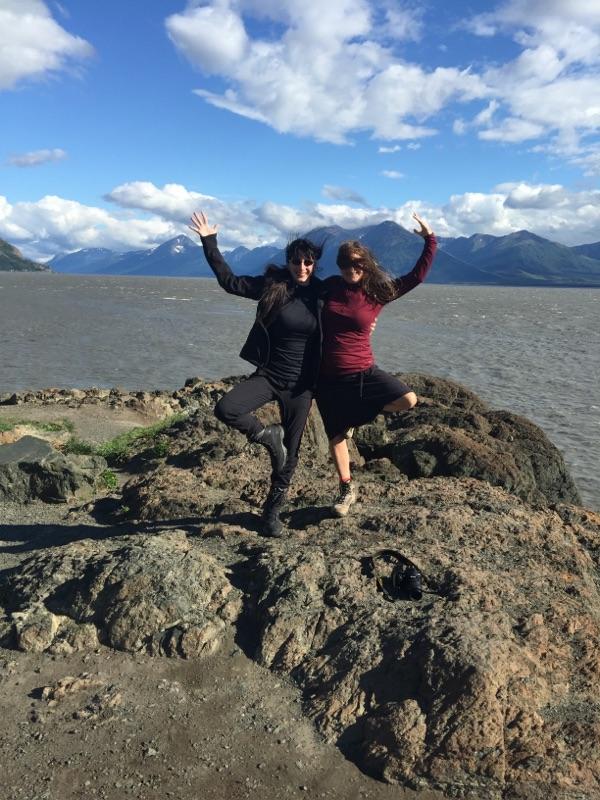
Teri on Mary’s Rock, Shenandoah NP Teri on Mary’s Rock, Shenandoah NP Kat and Teri Trees near Anchorage, AK. T’was windy. You can’t see the evil I gave. 😛
It sounds like the start of a support group, and maybe it is. For those afflicted with EDS, frequent joint dislocations/subluxations, chronic pain, and fatigue but who want to stay active on the trails like I do, then support is exactly what we need. I’m talking stability belts, braces, tapes, and hiking poles in this case. 🙂 However, I’m also here for you if you seek emotional support as well. ❤ I completely understand loving an activity and struggling to continue with it, or having to give it up entirely—yoga and dancing, for me. 😥 Kayaking and cycling are questionable at the moment. However, to keep me hiking, I’ve spent the last year working with the best physical therapist I’ve ever had (and I’ve had many, for different joints, over the last 25 years). Dave Miers is the only board certified orthopedic and fellow trained in manual physical therapy in Cincinnati, Ohio, and I owe him my life (on the trails). https://www.mierspt.com/
About twenty-plus years ago, I fell in love with mountain hiking. I did my first summit hike in the Uintas Mountains and have since blazed every day-hike trail possible in the Wasatch Mountains in Utah. I’ve hiked stunning canyonlands in Utah as well: Bryce Canyon, Snow Canyon, Zion National Park. I’ve booted many miles in reserves, state parks, and national parks in many other states too: Alaska, Hawaii, Colorado, California, Montana, Nevada, Virginia, West Virginia, North and South Carolina, Florida, Georgia, Tennessee, Kentucky, Ohio, New York, and lately Pennsylvania. I’ve even put in miles in Grand Cayman, France, Italy, and England. If I had my way, I’d hike the entire planet.
But, a little over a year ago, I couldn’t even walk a quarter of a mile.
Why? This requires a little background information…
I have problems with most of my joints; it’s probably easier if I list the unaffected ones: ankles and toes. Although, my left foot is perpetually swollen because of tissue fragility and leaking cells. Anyway, this post is about the powerhouse of walking: the pelvis and sacroiliac joint. You thought I would say legs, didn’t you? 😛 Guess what they’re connected to? 😉
So…I’ve had “hip” pain since I was 32 years old (I’ll turn 51 this April 2019), and seen various orthopedics and physical therapists to help me to no avail. I’d even had surgery for FAI impingement in 2014 and steroid injections. As it turns out, it’s not quite my hip joint–it’s my entire pelvis, which one physical therapist who specializes with EDS patients called “wibbly wobbly.” She actually “fired” me from her care because my pelvis was too hypermobile! Yes, my pelvis is very hypermobile, the most hypermobile of any of Dave’s EDSers. The root of my problem is “loosey-goosey” (doctor’s phrase, not mine. I’d say “lax”) ligaments and sacroiliac (SI) joint dysfunction.
The strongest ligament in the body on me is too stretched, too loose, and cannot hold the joints in place. Quite often I suffer subluxations, or partial dislocations, of my sacrum and/or my ilium. If they go, then the lumbar spine tends to follow. Basically I’m Humpty Dumpty, and my physical therapist has to put me back together again, and again, and again. After adjustments, he guides me through different strengthening and stabilizing exercises, and amps the challenge as I master some. He’s taught me how to properly walk, sit, stand, enter/exit a vehicle, and climb stairs–yeah I did all those incorrectly because chronic pain has a way of rewiring your mechanics and disconnecting the brain. A lot of the therapy is retraining your brain with the body, and I have gotten stronger and gained more of my function and ability back, at least when it concerns walking/hiking.
Although my sacrum pops constantly out of place, typically the left side shifting downward and twisting inward, my ilium stays more often than not in its neutral, normal position. That said, two months ago I partially dislocated my ilium while rolling over in bed and reaching down to turn off my alarm. Yeah, I hurt myself sleeping. If you have EDS, you probably have as well. I did learn self-correcting techniques for my sacrum and my ilium, and I can say it’s easier to reset your ilium than your sacrum. I’ve only ever been successful once. At least intentionally, I’ve “accidentally” self-corrected randomly simply by being and moving around with enough force to correct it. Or coughing. I seemed to have popped my sacrum today with a cough–though, in or out, only an x-ray or my physical therapist would know.
If you have SI joint dysfunction, you might be interested in these videos for self-correcting the sacrum as suggested by Dave Miers:
Self-correction for the ilium. If the one side doesn’t work, try the other!
Now, for the gist of the matter: Hiking Tips for the Hypermobile Hiker!
1. Consult your doctor and/or physical therapist about the type and intensity of activity that suits your ability. As I’ve mentioned, I’ve had to quit certain activities and for what remains I’ve had to accept limitations and modifications. I can hike within reason but can no longer do rock scrambles, or very strenuous or very long hikes. I tend to hike the easy-to-moderate trails now. Even though my physical condition and abilities have declined, I am better off than many with EDS because I maintained a very active lifestyle and kept as fit as possible, considering. I might be the most hypermobile EDSer under Dave Mier’s care, but I’m not in the worst shape. I’m a proponent of “move it or lose it” despite doctor’s advise to stop, despite the fact one told me I was “very brave” to do what I do. As I tell my mom who worries, I’m going to hurt myself “being”; I might as well hurt myself having fun. 🙂 Your opinion may differ. 🙂 But attitude is part of the battle in managing EDS. Pain is much harder to cope with if you’re also depressed. ❤ Hiking is my natural anti-depressant.
Not only consult the experts about what to do, but how you should do it. Dave designed my program centered on my goal to hike. His individualized care has made a world of difference. I can’t give you medical advice on what exercises you should do and leave those tips to your care provider. I highly recommend finding a manual physical therapist fellow–trust me, I’ve been seeing physical therapists since I was 25 years old, and I’ve failed physical therapy every time until I met Dave Miers.
2. Buy the best pair of sturdy boots you can afford. You’ll need the best footing possible on uneven ground, slippery rocks, snow, muck, when you ascend and descend, if you can rock scramble. Sole tread and grip matter too. If you have wobbly ankles like I do, then you’ll need good ankle support. You’ll need good arch support. Ultimately, the boots will have to be comfortable. REI has a rock prop for you to test boots. Or hiking shoes, if you decide you don’t need ankle support.
My new spring, summer, and fall Oboz boots (https://www.rei.com/b/oboz), and my winter Columbia Arctic omni-heat and omni-grip boots (https://www.columbia.com/technology-omnigrip/). Unfortunately the Arctic Trip boots are last season and probably unavailable. Wearing those boots keeps my feet warm, and I rarely have warm feet in the winter!
3. Get some trekking poles with a comfortable grip. I couldn’t believe the difference hiking with and without poles, and wished I’d been using them the entire time. Using the poles takes the pressure off my knees. Usually after hiking my knees would swell and hurt. Now I can hike without knee pain! Or a knee brace or tape–neither of those helped me because my knee caps move way too much. As an aside, one time during physical therapy, I mentioned my knee kept moving while I did the exercise. Dave tried to hold it in place while I performed the motion. My knee still moved! He gave up, knowing it was a lost battle. Wiggly knee wins every time. So, who wants to buy my expensive knee brace that can’t hold my knee? Only used once. 🙂
4. Wear your joint stabilizing belt, braces, or tape. I gave up the knee brace, but for my SI joint dysfunction, I wear a sacroiliac belt. Although the belt doesn’t hold my wigglier-than-my-knee sacrum in place, it definitely keeps my ilium locked in a normal position when I hike (not so much when I kayak). The one time I forgot to wear my belt on a short forest hike I ended up with a twisted torqued pelvis. Furthermore, the SI belt may not protect you if you fall.
Taping or wearing shoulder braces will also help your SI joint–subluxation of the shoulders will cause subluxation of the cervical spine, which will cause subluxation of the SI joints. Shoulder bones connected to the hip bone. 😛 I can’t tape myself and haven’t yet decided on which brace to buy (too many options). If you have a favorite, please let me know in the comments. 🙂 I still think a biomedical engineer needs to create synthetic spider webbing for us EDSers. 🙂
5. Get professionally fitted for a backpack. You’ll regret hefting the weight if you carry the wrong backpack for your body. The unbalanced weight will strain your neck, shoulders, back, hips, and knees, and you’ll ache at the very least. Matter-of-fact, my physical therapist advised wearing a backpack instead of carrying or pulling luggage. I wear a small backpack instead of carrying a purse to balance the weight, and of course I have an XS 40L backpack for my back-country trips, but I only carry 20-25 pounds (ultralight backpacking!). https://www.ems.com/the-north-face-womens-terra-40-backpack/1304688.html
6. Know your limitations. Hike only as far or as long or at the difficulty level your body can handle. Don’t hike twelve miles as soon as you get the green light from your physical therapist and then complain about hurting. Not saying this happened to me, but it happened to me. 🙂 I tend to overdo it, but on long backpacking weekends, I now only hike to the point I feel the first sting of pain and stop. I no longer push myself through the pain, which is what I’ve done all my life until the last year. Understand your thresholds, whether it’s distance, exertion, temperature, fatigue, pain. These may help you avoid injury or the inflammatory flares.
7. Prepare to manage the inflammatory flares. Even on long backpacking trips, I bring what’s necessary to decrease inflammation. Inflammation is a state of being when you have EDS, and working joints and muscles will exacerbate inflammation. I rely upon a variety of measures: (1) grape seed extract and turmeric extract; (2) portable TENS; (3) Max-Freeze (I prefer it over Biofreeze and Icy Hot); (4) my icy gel pack or ice; and (5) rest. ACE bandages and shoulder slings come in handy too. I also take Indomethacin, a prescription non-steroidal anti-inflammatory, daily because I have hemicrania continua, a rare chronic headache condition. I’m not sure if Indomethacin helps my joint pain because I always have joint pain, but maybe the pain would be worse if I didn’t.
What tried-and-true at-home self-care methods do you use?? 🙂
8. Adopt an anti-inflammatory diet. Certain foods produce a pro- and anti-inflammatory response in your body. You’ll find lots of information on the internet about an anti-inflammatory diet, which foods to include, which to exclude.
As for me, I opted for a vegetarian diet 18 years ago, but, because of high insulin and low sugar health problems, I needed to further restrict myself. I only consume 50-60 grams of carbohydrates a day and eliminated gluten. As a result, I feel better, lost 16 pounds of water weight caused by high insulin, and experience the benefit of pain reduction, especially for my headaches. I discovered gluten triggers the worst of my head pain. I will admit my diet presents a challenge at times and demands careful planning to meet my nutritional and appetite needs. The benefits far-outweigh the cost of effort though.
In my camper cooking blog (https://wordpress.com/block-editor/post/thewanderfullife.home.blog/158), I mention I’m a fan of organic foods. I’m also a fan of non-GMO foods (because of the lack of transparency–what’s in my food? An additive that’s pro-inflammatory? A chemical that artificially raises insulin?) and sustainably produced foods, such as eggs and dairy from pasture-raised animals, or palm oil, which if not sustainably produced contributes to deforestation and the endangerment of tigers, elephants, rhinos, and orangutans. 😦
If you watch Forks Over Knives (Netflix), you’ll learn a lot about the food industry and human, animal, and environmental welfare. Adopting a whole food, plant-based diet could reduce disease risk and boost your health and body’s maintenance and function.
An EDS expert states the whole food diet, as well a paleo, raw, Mediterranean, and vegetarian/vegan follow the approach she recommends for those with EDS. Many of us have digestive issues, such as gastroparesis, or food sensitivites because of mast cell activation syndrome (MCAS). We need the most appropriate fuel for our bodies. I’ve provided the link to that information: https://issuu.com/markmartino8/docs/eds_nutrition_and_supplements_heidi
9. Repair and build muscles with a protein bar or drink. While whole foods contain the amino acids your body needs to repair or build muscle, I feel my muscles need the extra boost. Overstretched, weakened ligaments and tendons cannot hold the joints as intended, and cause joint instability. The muscles, thereby, double duty as muscles and connective tissue, holding the joints and moving the joints. Fatigue and spasms ensue.
As you age, you tend to lose muscle, but as someone with EDS, you need more muscle. It feels like an uphill battle, and sometimes I think all I can do is maintain my muscle rather than increase muscle mass. I tell my children–my daughter confirmed with EDS, my son suspected–to get strong and then get stronger. That’s the legacy I leave for the genetic lottery we’ve won.
My favorite brands of protein powder are Garden of Life and Sun Warrior. They both have BCAA’s the building blocks for muscles. Since I have a low-carb diet and need to avoid maltodextrin/dextrin (raises insulin), I have two choices for bars: Quest Bars and Power Crunch’s Snapsticks. Also, I ❤ the Koia convenient ready-made protein drinks ( https://drinkkoia.com/). Other options to increase protein and omega-3 fatty acids are flaxseeds, chia seeds, and walnuts. The problem with those is the volume you need to eat. 🙂
10. Use foam rollers to stretch and calm your muscle tightness. My most important rule: NO STRETCHING! Stretching only further weakens already over-stretched ligaments, and you’re more likely to hyperextend a hyperflexible and hypermobile joint. We all know what that means: PAIN and DAMAGE to the joint.
The first time I used a foam roller on my quads I wanted to cry. Yet, over time it does work. I have a large roller and small roller. You’ll find a myriad of roller types and size. For some spots, you can even use a tennis or rubber ball.
If you can afford the luxury, pay for a medical massage. They hurt more than the roller, but…:)
11. Enjoy life and this world. We’re not long in it, and you might as well go into the grave with a defective, broken well-used body than a hardly used one. You’re going to hurt yourself no matter what you do.
If you have EDS and TMJ you’re not allowed to yawn. You have to push your thumb against the bottom of your jaw to keep it from opening.
You might as well enjoy the sights and sounds, even if the sounds are your joints popping.
Some trails and scenic lookouts are wheelchair- or walker-accessible. Don’t let disability actually disable you from experiencing wandering into the wonder. ❤ I’m hiking with my legs until I can’t use my legs, and then I’m going to hike with my arms, or make Shane push me. 🙂 http://wheelchairwandering.blogspot.com/2017/05/accessible-trails.html
I’m going to be in pain, whether I sit, stand, walk, talk, eat, or breathe. At least when I’m hiking I have a very good and acceptable reason for the pain. 🙂
Shane and I embarked on the wanderful life without researching whether we had the personality traits to live full-time in a camper. For a very long time, he dreamed of a nomadic life, where he could work and travel at the same time. He knew he could live in a tiny space and could adapt to any situation. His life experiences taught him such. But, when he asked me to join him, he had to dangle the most delicious carrot (“you can write your novel and hike”–ummm, yes please!) for me to consider this as a lifestyle. Living full-time in a camper was the polar opposite of my desire to settle down as a homesteader. I wanted to buy land, build my off-grid sustainable house, plant a garden, raise chickens and bees, and maybe have kids, the kind that bleat and devour grass, hats, and anything they can chew. 🙂 OMG I ❤ this baby goat: https://www.youtube.com/watch?v=AWvefaN8USk
Why did I agree then? The carrot and the person holding the stick.
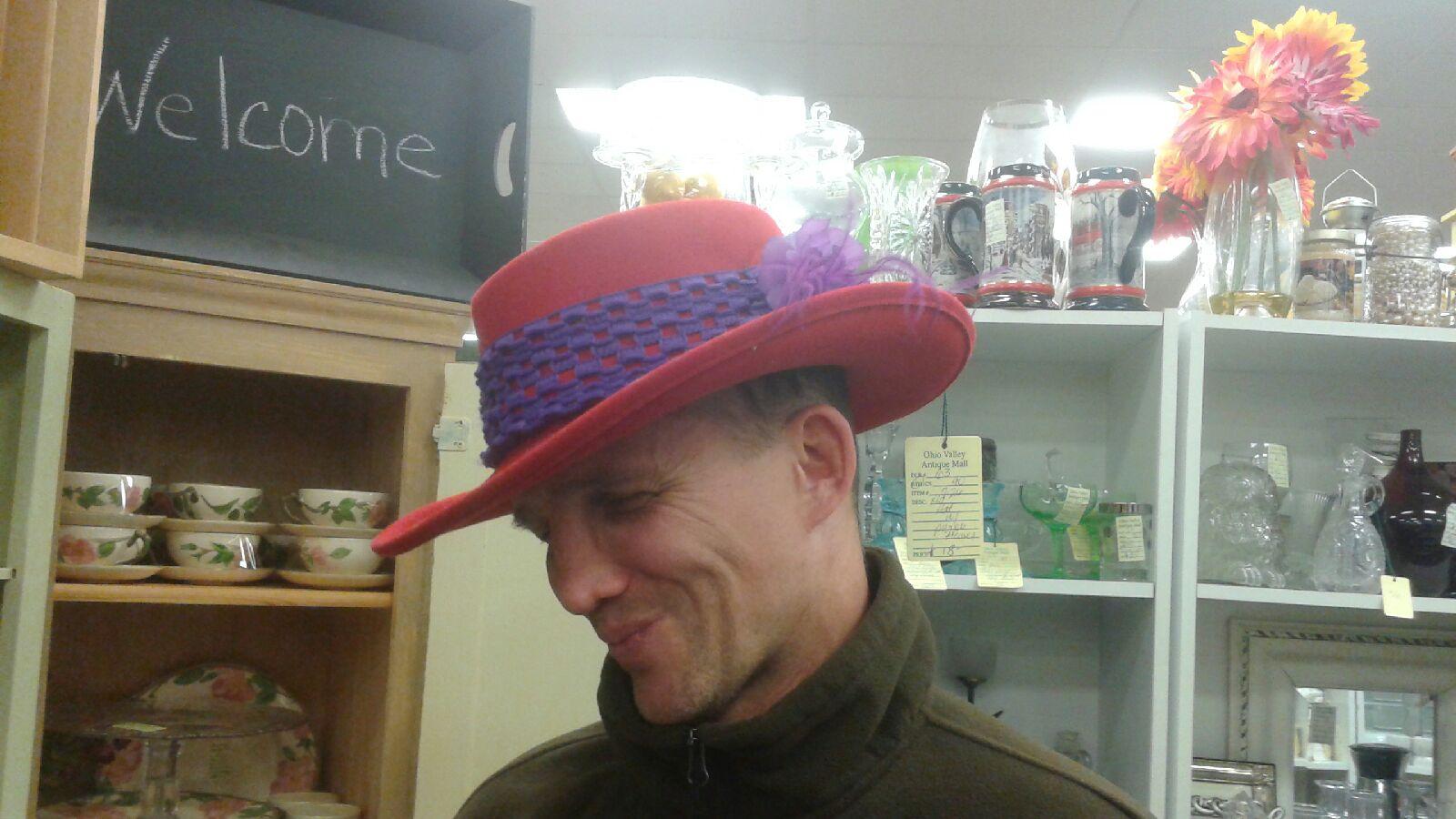
The person holding the stick. 🙂 Steampunk Assassins for friends’ Halloween party.
Home is where the heart is, and Shane has my heart. ❤ Not to mention, my heart sings in nature, while hiking and exploring new places, while writing. He simply had found a way for our dreams to collide.
On Halloween 2020, I plan on getting Mauied with him (aka married in Maui). I’ll definitely find out if we’re truly meant for each other, as my friend Missy pointed out. My friend Alex posted this funny meme on my Facebook page:
Even people who don’t live full-time in a camper recognized the challenge. But, as individuals can we overcome the challenges? What about as a couple?
Adventurous (√—we
backpack, kayak, and snorkel. He skydives, while I hang-glide.)
Adaptable
(√—the
fact we’ve both not only
lived through potentially
life-shattering situations
but thrived regardless attests
to our adaptability. We have good coping strategies, albeit I’ve
needed to enlist new ones when I lost my tried and true ones.)
Independent
(√—we’re
both very happy on our own, doing our own thing)
Self-sufficient
(√—off-grid
is the dream! Our Geo Pro has solar panels and batteries,
fresh/grey/black water tanks, and propane tanks. It also has an
off-road package.)
Organized
(√—the
first blog illustrated this. Now, we deal with getting in each
other’s way with humor. Case in point: he told me to get my sh*t
out his way. I told him his way was in my sh*t. We had a good
laugh.)
Dedicated
(√—I’m
so dedicated I started a blog to chronicle this wanderful life!)
Open-minded
(√—we’re
willing to go anywhere)
Frugal
(√—this
is why he chose to do this. We’ll save money! We certainly can’t
buy anything because nothing else will fit. LOL In the end, our
goal is to save
enough money to buy a
larger plot of
land or more goats.).
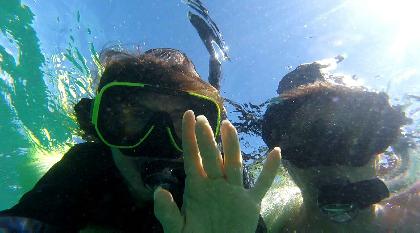
Adventuring in the Florida Keys Paddling Duckies on the Lower Yough in Ohiopyle, PA. Shane’s so adventurous he’s going backwards down the rapids. 😛
Those personality traits will bring two people together on the full-time camper/RV path, but they may not keep them together. Living in a small, cramped space alone has its frustrations; living in a small cramped space with another person always invading your space will double frustrations and might cause division in ways other than “the cabinets on this side are mine, the other yours.”
We agree with It’s a Necessity (http://www.itsanecessity.net/2017/01/relationships-in-small-spaces-how-to-survive-cramped-living). To succeed in a long-term committed relationship, whether in a small space or not, couples need healthy ongoing communication, respect, praise, gratitude, laughter, and a life outside the small space. All the wide open spaces are yours when you live in a camper!! That’s why it’s the WANDERful life. 🙂
To
all the above, we would add three other significant characteristics
you cannot do without:
Cooperation—couples
who work as a team will accomplish more, and their camper will run
like a much larger efficient house. Settle
into a routine; assign specific responsibilities between the two of
you (or to everyone in the family); tackle problems and brainstorm
solutions together; do what needs to be done for the other person,
for the team.
Goofiness—life’s
too serious to take seriously. Couples
who play together stay together, and
we fully intend on goofing off.
Pretty sure our camper
neighbors think we’re nutball. LOL We
expect things to go wrong; we expect to butt heads (like goats) and
step on toes (probably more
literally than figuratively).
However, we expect the fun
times to outweigh the un-fun times. We love this wanderful life thus
far and feel eager about where we will wander into wonder.
My mom’s embarrassed to call me her grown daughter, I’m sure. LOL So pretty. 😀 ❤ *snicker snort* The things he’ll do for me!!! His mom will be shocked, but probably not surprised. He’s her wild child. ❤
3. Most importantly…When I asked Shane what traits you need as a couple, all he simply said was “Love.”
I love to cook and bake, but I’ve not done a lot of camper/camp cooking. Shane and I backpack, and we rarely bring a camp stove or food to prepare. So full-time camper living has thrust me into new territory, literally and figuratively. 🙂
Firstly, I had to downsize. I left most of my bakeware and cookware back home, as well as appliances such as my professional Kitchenaid stand mixer. Space is limited, and the convection microwave oven is small itself. If I bake, I’m restricted to mini pans. Thankfully I have those and packed every single one. 🙂
That said, I brought my bulky Instant Pot. Why? It runs off electricity (off-grid with solar power or hooked into campground) instead of the propane that fuels the stove. Considering water vapor is a byproduct of burning propane, we want to minimize the use, especially during the winter when we’re trying to keep humidity down.
Therefore, I’m converting my stovetop recipes to make in the Instant Pot. One of my favorite winter recipes I have created is what I call Moroccan Lentil Stew, and I made it in the Instant Pot for the first time!
Is this dish really Moroccan? In theory perhaps. I don’t know if Moroccans have made something like this at home, but I like to think they do. Harira is an authentic Moroccan soup made with lentils, chickpeas, and tomato. My stew has lentils and tomatoes but no chickpeas because Shane’s not a fan of them. I ❤ chickpeas, but I ❤ Shane too. Cooking for him is an easy way to show love, so I’ll sacrifice the chickpeas for him. That’s love.
My stew also incorporates traditional spices found in Moroccan cuisine: Cumin, ginger, paprika, cayenne pepper,and mint. I could add saffron as well, but the stew is flavorful without the most expensive spice in the world. Saffron is made of real gold I think. 😉
You could be more scientific with your spice measurements than I am. I simply scoop out a teaspoon or two of each. 😛 None of that half teaspoon. It’s all or nothing in my kitchen. 🙂
If Shane wasn’t sharing this dish, I would add a ton of cayenne pepper. My preferred spice level is “volcano”. You may want more or less. Shane has normal people taste buds though, and I must limit it to 1 measly teaspoon. Because I ❤ him and am not trying to kill him.
I think the Moroccan Lentil Stew is easy to prepare. For those with diet concerns, it’s vegan unless you serve it with feta cheese sprinkled on top. Shane doesn’t like feta cheese either. So he eats the vegan version.
The first step involves chopping your onion. It doesn’t matter if you chop half, a quarter, or a whole. It depends on how much you like onion. I only use a quarter to a third. You can decide how big the onion bits will be too. Cooking is all about your tastes!
In the Instant Pot, you’ll select the “saute” function. Measure out at least a tablespoon of olive oil and add to pot. Unless you’re like I am, then just pour to coat bottom because “good fats!” Saute your onions until soft and golden. If they’re brown, you’ve caramelized them, but it won’t affect your dish. 🙂
I like to add my spices after sauteing and mix with onions for 10 seconds. The onions soak up the spices. Greedy ogres. Ogres are like onions, if you recall.
Next dump in the can of lentils and tomatoes.
I’m a fan of organic foods and fire roasted tomatoes. You can choose whatever you prefer: roasted, not roasted, diced, crushed, stewed, not canned. 🙂 I can’t wait until I have a garden to grow my own vegetables. 🙂
Stir the pot. I pour in at least a cup of water as I want it more liquidy. Not enough to make it soupy though. Then I throw in a bunch of spinach.
Now the easy part of cooking. Close the lid on the Instant Pot, set it to “stew”, and for 10-15 minutes. Not the 20 minutes I set. I stopped the cooking before the timer because all the hissing. My Instant Pot was really steamed. Lol
Despite using a heated water hose, heat tape, and skirting around the camper, we’ve unfortunately succumbed to a very common problem for RVs and campers in frigid temperatures: The water pipes froze. It occurs when temperatures drop into the teens and below. Over the weekend, we received 7 inches of snow, and the temperatures dropped below zero. No doubt our water pipes froze. I’m surprised my blood didn’t freeze inside my veins when we ventured outside.
We thought we had prepared and would prevent this from happening. However, our neighbor informed us that no amount of insulating would hinder water pipe freezing in a camper not built for all-seasons (like his, like ours we discovered recently), or those without Arctic packages (I’ve since learned about this after the fact). He encountered the same problem his first winter and discovered only one thing that works: Keeping the water running at a trickle when he knows temperatures will drop into the teens.
This won’t help us now, though. We’ve got to figure out how to thaw the water pipes. As a hopeful solution, we’ve added foam insulation to the pipes we have access to and installed a very small ceramic heater in the compartment where the water heater and those pipes exist. We’ve positioned the electric space heater to heat underneath the sink and in the shower periodically. Thus far, I’ve only seen a few water drops from the faucet. Perhaps a sign the water pipes are thawing, albeit at such a rate I fear we won’t have water until spring. Or maybe Wednesday when the outside temperatures rise to 45*.
We’ve learned very valuable lessons from this, and I want to pass the wisdom (which we lacked) onto others who read this post and plan on buying an RV or camper they hope to use in all seasons.
The most important tip is to RESEARCH!!! Research which campers are all-season.
Don’t rely on the “expert” salesman to help you. The sales manager at Camping World neglected to inform us our Geo Pro was NOT an all-season camper, even though he knew our intent to live full-time in a camper and knew we would live in a cold-clime area. We didn’t discover this fact until I called Forest River about the water heater issue (which they have quickly resolved by agreeing to send us the required part to fix the water heater). In the future, we may find our walls (made of fiberglass, which may become brittle in the cold) may buckle because of the cold and moisture. The insides of my clothes cabinets have iced up on the inside! Frost has accumulated alongside the mattress and the camper’s seat cushions. Eventually we’ll have to scrub off mildew and mold, even though we’re using electric heat and a dehumidifier. We can only hope to truly weather winter in our toy trailer meant for spring, summer, and fall.
In the meantime, I will definitely call Camping World Headquarters to complain about their lack of due diligence and ethics. 😡
Watch all the YouTube videos you can find that guide you on your new journey living on the road, in campgrounds, boon-docking, etc. While we did this, we seemed to have missed the information on all-season campers and didn’t know about such a thing to even think to research it. Even if we did it over again, unless we had this foresight, we’d have made the same mistake. We wouldn’t have looked for the right camper for the living conditions beyond comfort, price, hauling weight, and off-grid options (e.g., we have a solar panel and batteries).
But, you’re forewarned! Know where you’ll park your camper or RV; know if you plan to “snowbird” (aka “pack up for the winter and head south, if you’re northern”) or plan to rough it through unkind winters. If you’ll adopt a snowbird life, then you can relax standards for your camper or RV. If you’re going to be a snowy owl, like we are, check out this site that will help you determine your needs and how to go about finding your perfect home no matter where you park it: https://rvshare.com/blog/want-to-buy-a-four-season-rv/
Frozen! Let it snow! Let it snow! But let our water pipes go!
Update: Water runs again! The pipes have thawed! Yay!
On Shane’s day off, he wanted to see the old 19th century gristmill (grain grinding mill) and covered bridge (an 1874 Howe truss built on a stone foundation, only one of two covered bridges remaining in Lawrence County, PA). Then find and explore the caves a local mentioned. We’ve only ever gone spelunking with a guide in Laurel Caverns (Ohiopyle, PA), where we learned two types of cavers exist: Climbers and Crawlers. I’m a Crawler. 🙂 To crawl through caves unguided tempted us out into the cold and snow. 🙂
Without a map or trail sign, we followed the directions given to us: cross the covered bridge (yes, it’s still in use) and head up McConnell Mill Rd. We didn’t see a trail off the road, but she’d told us if we missed it, we’d turn right at the log cabin.
Log Cabin, McConnells Mill Rd.
We continued down this road, perhaps a half mile, until we found a picnic area. But no trails. No rappelling lines. No caves.
At this point, I decided to check out Slippery Rock Creek down the hill. Without a trail I needed to proceed with caution. Numerous accidents resulting in injury or death have happened at McConnell’s Mill State Park–falls, drownings, and even a hiker strangled to death (not by vines or tree dryads, but by another person! *gasp*). The area is rife with natural hazards. But I’d grown up exploring creeks and scooting down hillsides. This snowy hillside I literally scooted down on my bottom. 🙂 It might look funny, but I can’t fall if I’m already down on the ground. 😉 That’s my tip on proceeding with caution. LOL
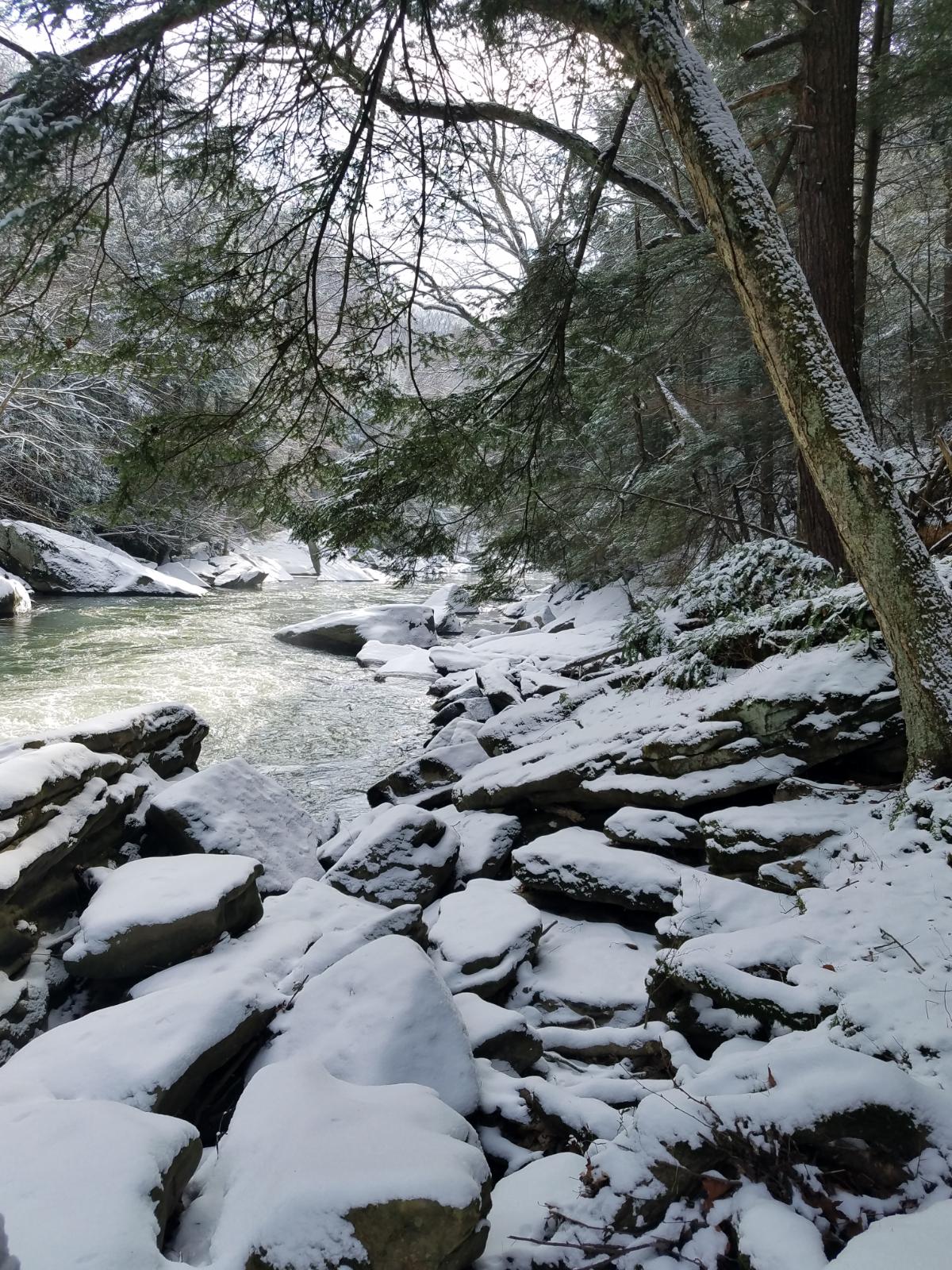
Slippery Rock Creek, McConnells Mill State Park. Alpha Pass on the other side.
Again, Slippery Rock Creek mesmerized. We saw hikers across the stream, so I knew approximately where we were on a map. You probably could find our approximate location too. Somewhere near the rappelling symbol. We didn’t encounter the end of the Rim Rd. nor Wilson Rd forked on the left.
Feeling a bit dejected and hungry as the time neared late lunch (elevenses had already passed, so I clearly was a famished Hobbit), Shane and I climbed up the hill and headed toward the road. We’d given up the chase for caves.
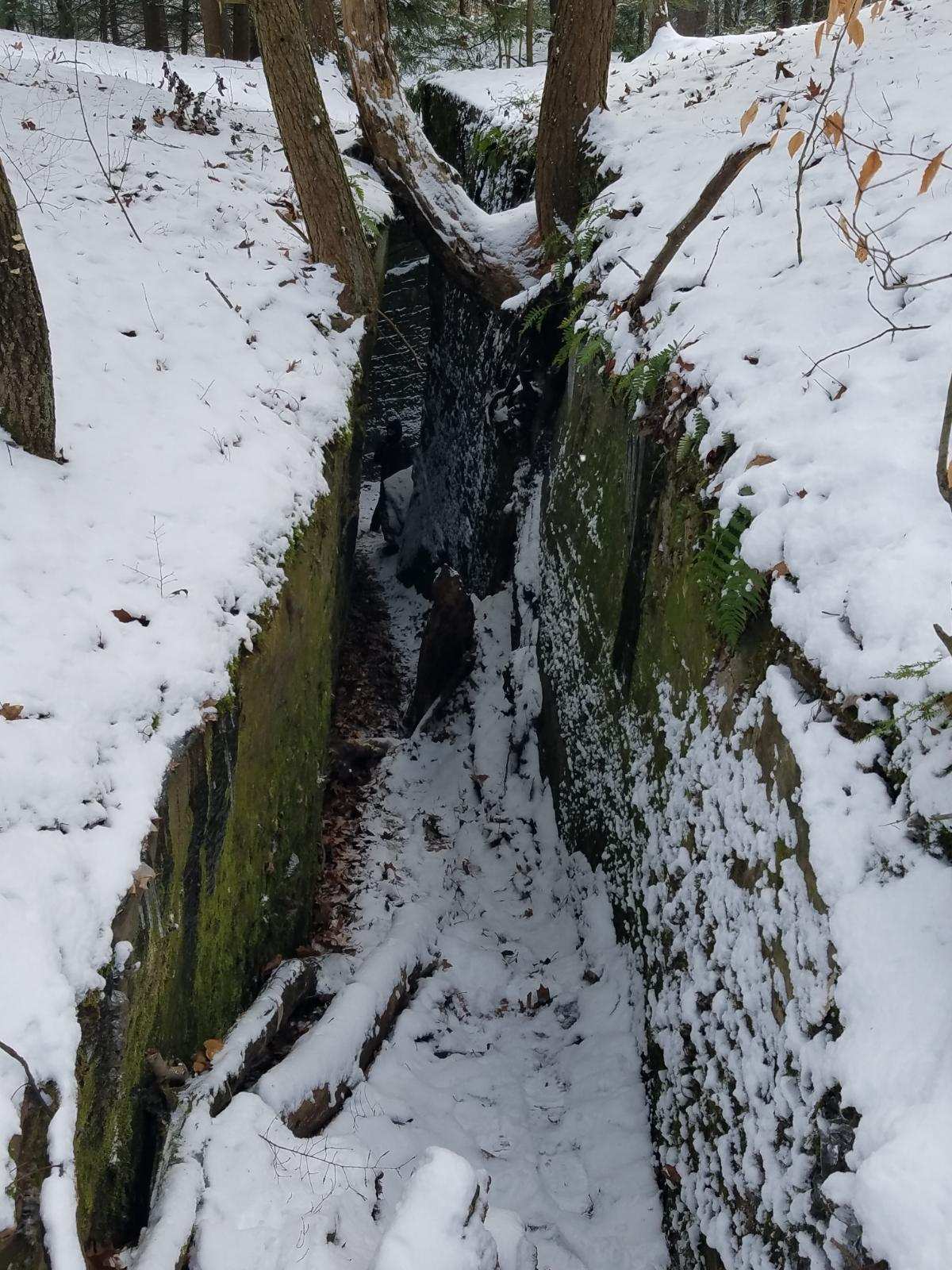
And, just like in Hollywood, the magical moment: rock walls and crevices appeared to our left. We jaunted over the rocks and through cracks.
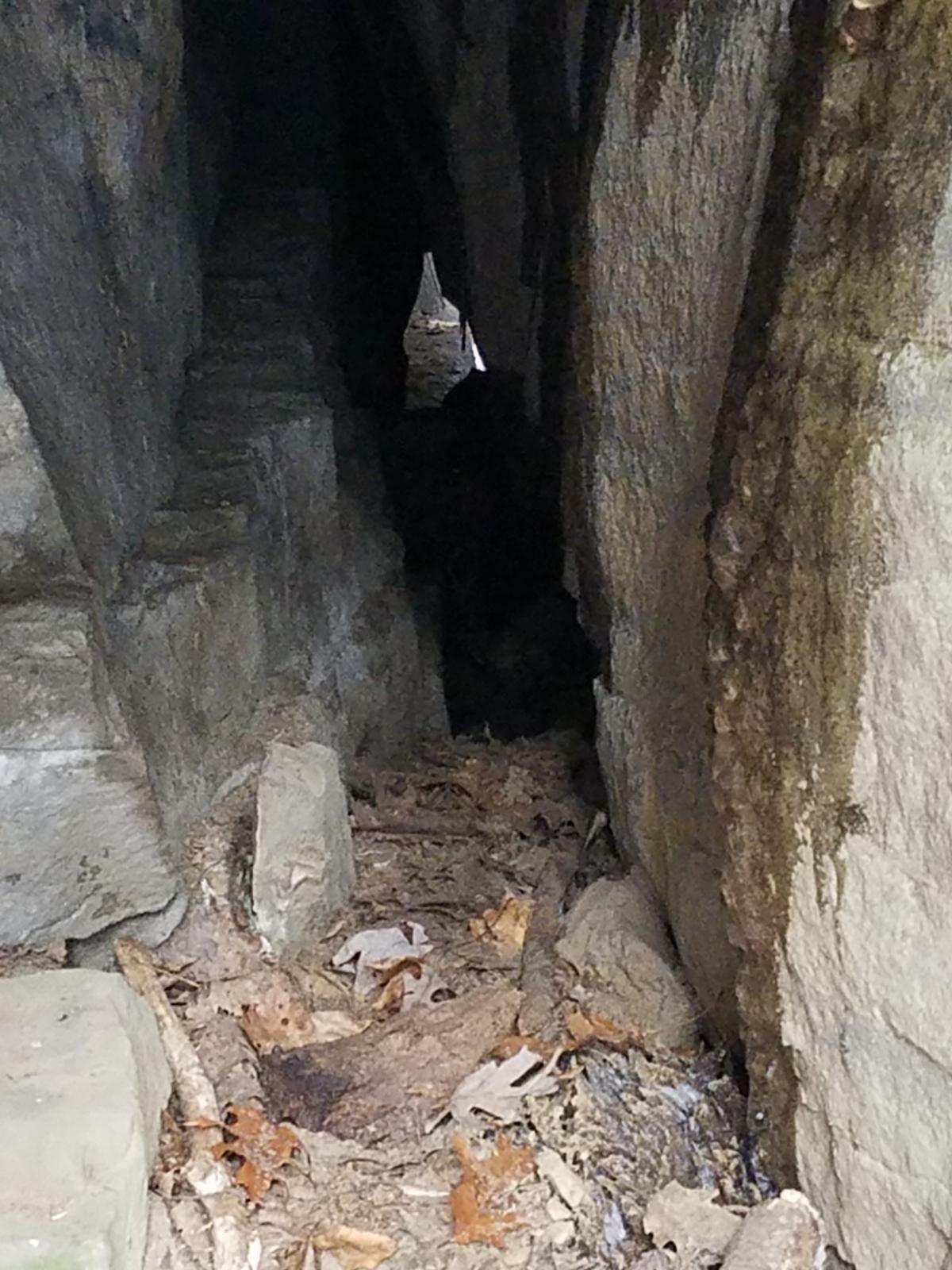
We found a couple small caves, but they ended too quickly to explore. Either we didn’t find the openings that led to deeper sections, or those entrances had become blocked by cave-ins.
Neither of the two openings led farther than 8 feet into the dark. Each required a squeeze to navigate. If we had more time, maybe we would have found more promising cave openings and tunnels. The area had plenty of rocky cliffs to climb (or crawl).
We did, however, discover an exciting gem, gleaming in the gloom!!! We truly did wander into a wonder!
Ice Dragon!!! ❤
Perhaps we had stepped into the dragon’s lair, or the fossilized maw of a great dragon, its teeth glistening still.
For what it’s worth, we found a cavern, albeit with a sliver of its roof opened to the sky, but replete with icy stalactites and stalagmites.
Icy stalagmite, formed as water dripped from the long icicles hanging from the ceiling and froze, layer upon layer.
We had a splendid time scrambling over rocks, creeping through crevices, and enjoying the sights. Last but not least, the late morning light enabled me to take some beautiful photographs of the serene Slippery Rock Creek.
McConnell’s Mill Covered BridgeMy absolute favorite shot of Slippery Rock Creek before the falls at McConnell’s Mill.




 Anyway, this post is about the powerhouse of walking: the pelvis and sacroiliac joint. You thought I would say legs, didn’t you? 😛 Guess what they’re connected to? 😉











 The Wanderful Life